
CE Certification Guide for BBQ Gas Grills
European Compliance Requirements, EN Standards & Import Rules Explained
If you plan to import BBQ gas grills into the European Union, CE certification is not optional—it is a legal requirement. Any CE certified gas grill sold in EU member states must comply with the EU Gas Appliance Regulation (GAR) and relevant EN standards before entering the market.
This guide is written for European importers, wholesalers, retailers, and private label brands who source BBQ gas grills from China and need a clear, practical understanding of CE certification—without legal confusion or technical jargon.
What Is CE Certified Gas Grill?
CE certification confirms that a BBQ gas grill complies with EU safety, health, and environmental regulations.
For gas grills, CE marking demonstrates compliance with:
- Gas safety
- Pressure control
- Flame stability
- Mechanical strength
- User safety
- Material compliance
Without CE certification, gas grills cannot be legally sold in the EU or UK (UKCA applies separately).
Which EU Regulation Applies to BBQ Gas Grills?
Gas Appliance Regulation (EU) 2016/426
All BBQ gas grills fall under the Gas Appliance Regulation (GAR), which replaced the old Gas Appliance Directive.
GAR applies to:
- Outdoor gas grills
- LPG / propane / butane gas appliances
- Built-in and freestanding BBQ gas grills
GAR focuses on:
- Safety during normal use
- Prevention of gas leakage
- Stable ignition
- Flame control
- Mechanical and thermal safety
Mandatory EN Standards for CE-Certified BBQ Gas Grills
Core EN Standards
Most BBQ gas grills for Europe must comply with:
- EN 498 – Outdoor gas cooking appliances
- EN 484 – Multi-burner gas appliances
- EN 437 – Test gases, pressures & categories
- EN 60335-1 / -2 – Electrical safety (if electric ignition exists)
⚠️ The exact standards depend on grill structure, burner count, and ignition system.
A professional manufacturer will determine applicable standards before prototype development, not after production.
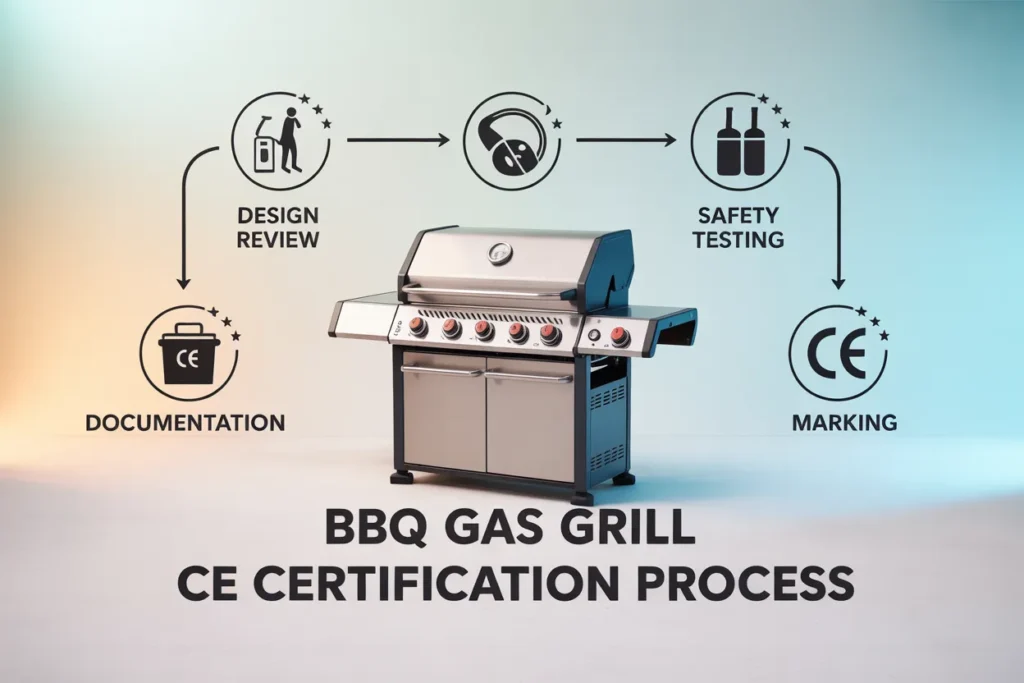
CE Certification Process for BBQ Gas Grills (Step-by-Step)
Step 1 — Product Design & Engineering Review
Before testing:
- Gas routing must be stable
- Burner layout must pass flame distribution tests
- Materials must meet heat and corrosion requirements
Experienced OEM/ODM factories like Longzhao Technology design products with CE compliance in mind from day one.
Step 2 — Sample Preparation & Pre-Testing
The factory prepares:
- Final production samples
- User manual draft
- Technical drawings
- Component list
Pre-tests often include:
- Gas leakage test
- Pressure resistance
- Ignition cycle test
Step 3 — Laboratory Testing (Notified Body / Accredited Lab)
Samples are sent to:
- TÜV
- SGS
- Intertek
- BV
Tests include:
- Flame stability
- Gas tightness
- Overheating protection
- Mechanical stress
- Safety shut-off performance
Step 4 — Technical Documentation (Technical File)
Required documents:
- Test reports
- Risk assessment
- BOM (Bill of Materials)
- Engineering drawings
- User manual
- CE label artwork
Step 5 — Declaration of Conformity (DoC)
The manufacturer or importer signs the DoC, confirming compliance with GAR and EN standards.
Step 6 — CE Marking & Mass Production
Once approved:
- CE logo can be applied
- Serial production begins
- QC must match tested samples
Who Is Responsible for CE Certification — Factory or Importer?
Short answer: BOTH.
Manufacturer (China Factory)
- Product compliance
- Test coordination
- Technical documents
- Production consistency
EU Importer / Brand Owner
- Market surveillance responsibility
- Storage of DoC & test reports
- Product traceability
This is why European buyers must choose a CE-experienced factory, not just a low-cost supplier.
Common CE Certification Problems (And How to Avoid Them)
Typical Issues
- Incomplete documentation
- Unstable burner flames
- Wrong gas category labeling
- Poor material selection
- Design changes after testing
- Using non-certified components
How Longzhao Technology Prevents These Issues
- CE-oriented design review
- Stable burner suppliers
- Locked BOM after testing
- In-house QC matching CE samples
- Long-term EU project experience
CE vs UKCA — What UK Buyers Need to Know
- EU → CE
- UK → UKCA (post-Brexit)
Many products now carry dual CE + UKCA marking.
Longzhao Technology supports both formats.
FAQ – CE Certification for Gas Grills
Q1: Is CE certification mandatory for BBQ gas grills in Europe?
Yes. All gas grills sold in the EU must comply with the Gas Appliance Regulation and carry CE marking.
Q2: How long does CE certification take for gas grills?
Usually 4–8 weeks, depending on testing and documentation readiness.
Q3: How much does CE certification cost?
Costs vary by model complexity but are typically €3,000–€8,000 per model.
Q4: Can one CE certificate be used for multiple models?
Only if the structure and components are identical.
Q5: Can Chinese factories handle CE certification?
Ensure your next BBQ event features a CE certified gas grill for maximum safety.
Yes—experienced OEM/ODM factories like Longzhao Technology manage the full CE process for European buyers.
Why European Buyers Choose Longzhao Technology
- 13+ years BBQ gas grill manufacturing
- CE / EN standard expertise
- 6,000+ units monthly capacity
- OEM & ODM support
- Serving 30+ European brands
We help buyers pass CE smoothly, reduce risk, and scale reliably.